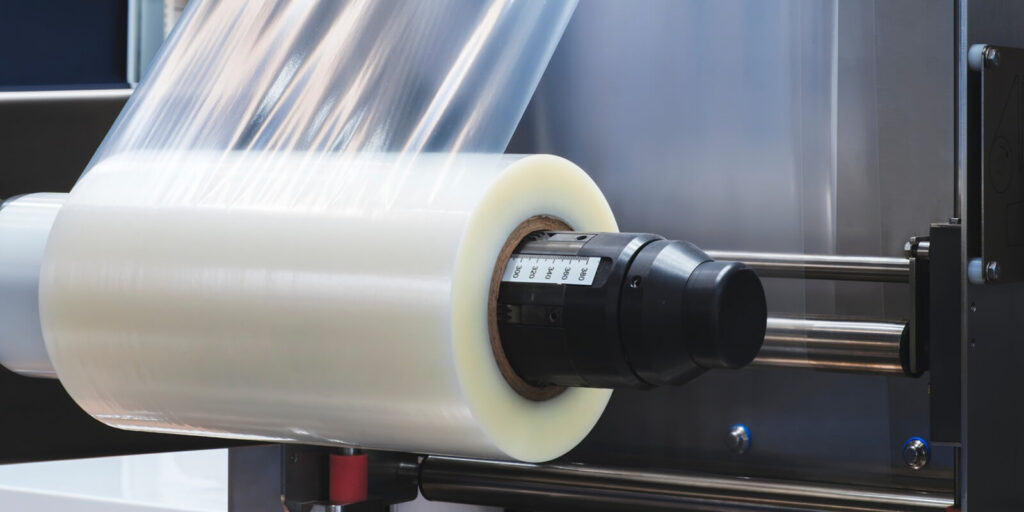
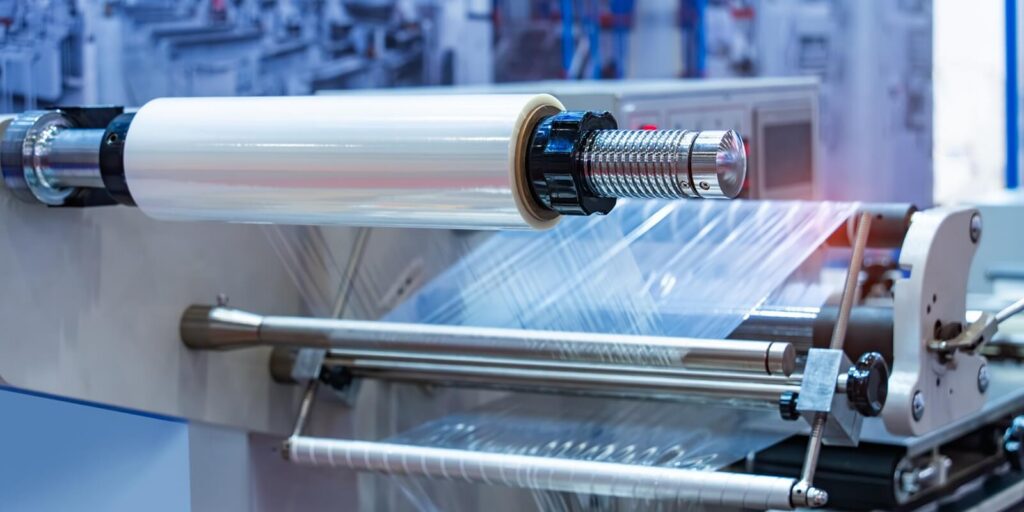
Flexible film recycling supports circular economy goals by recovering material most curbside programs don’t accept and returning it to production. Plastic Film Recycling, run by the Flexible Film Recycling Alliance (FFRA) offers an interactive map that aggregates more than 20,000 film recycling drop-off sites from over 60 retail partners and municipal locations across the U.S.
If your curbside recycling service doesn’t accept plastic film (and many don’t), your local grocery store may already be part of the network that does.

What the Circular Economy Means for Plastic Film
The circular economy is an economic model that works to reduce waste by minimizing single-use and first-use items and keeping products, materials, and resources in use for as long as possible. For plastic film, this means collecting used material, processing it for recycling, and transforming it into recycled resin that can be used to make new products, keeping valuable materials in circulation rather than sending them to landfill.
Many retailers accept plastic film made from two types of resin, labeled #2 (high-density polyethylene, or HDPE) and #4 (low-density polyethylene, or LDPE).
Why Curbside Bins Can’t Close the Loop
In most municipalities, flexible film doesn’t belong in a curbside bin. Material recovery facilities (MRFs) have traditionally been built for specific materials. Some are geared for rigid containers. Others focus on fiber. As packaging variety grows, MRFs are adapting, but flexible film still behaves differently than most items in the curbside stream.
Light, thin film can wrap around rotating equipment, tangle sorting machinery, and shut down a sorting line while workers cut the obstruction away by hand.
That’s not a failure of your recycling service. It’s a mechanical distinction, and it’s a major reason why flexible film needs a separate recycling stream. Alternative collection systems (ACS), which include store drop-off, municipal drop-off, subscription, and mail-in services, route flexible film to recyclers set up to work with the material.
How Store Drop-Off Keeps Film Moving Through the System
From a consumer perspective, store drop-off works a little differently than curbside pickup. Retailers place bins in convenient locations near their entrances. When customers fill the bins with plastic film to be recycled, the retailer either bales the film onsite or ships it to a consolidator. From there, recyclers grade the bales by resin type before further processing them into pellets that go into new manufacturing runs.
Many recyclable film products carry the How2Recycle Store Drop-Off label, the consumer signal that an item belongs at a retail drop-off bin. Some retailers also post a SmartLabel QR code you can scan for current information on what that location takes.
Plastic Film Recycling Options
| Channel | Location | Accepted Material |
| Curbside | Municipal bin at your home | Rigid containers, paper, some metals |
| Store drop-off | Retail bin near store entrance | Flexible plastic film |
| Municipal drop-off | City or county recycling location | Varies by locality |
| Subscription | Paid pickup service you sign up for | Varies by provider |
| Mail-in | Postage-based return service | Varies by provider |
Preparing Film So It Actually Gets Recycled
Once processed for recycling, recovered film can be made into a range of durable goods, including lumber and decking, stormwater management systems, construction materials, and other durable goods. To get there, the film has to arrive at the recycler in a state that’s ready to be worked.
For consumers, a little prep is all it takes before taking recyclable film to a drop-off location or mailing it in. The Plastic Film Recycling prep sequence is simple:
- Wipe items clean of any food residue or moisture
- Gather them for the trip to a drop-off bin or mail-in package
- Verify each one against the accepted materials list before it goes in
To validate that a film is appropriate for drop-off, first confirm what materials your location accepts, since acceptance can change over time. If you’re still unsure, try the stretch test. If you can stretch the film without it tearing, it’s likely recyclable. One major exception is cereal bags, which are recyclable even though they don’t stretch.
Measuring the Circular Impact
Measuring what a recycling system recovers matters because it shows how the system is working and how it can scale. Collection, sorting, and yield are all measured at different points in the chain, and there’s no single number that covers all three.
One collection figure comes from the biennial U.S. Post-Consumer Plastic Recycling Study, which is built from facility-level surveys. Nationally, film recovery reached 1,317.2 million pounds in 2024, up 206.8 million pounds from 2022, the largest increase of the measured plastic categories that year.
Role of Quality
Quality determines whether recovered film can displace virgin resin. A contaminated or mixed-resin bale will typically be downgraded into a different-use application rather than going back into packaging-grade pellets. For one example, composite decking manufacturer Trex sourced more than 1 billion pounds of reclaimed polyethylene film and wood scrap, including 377 million pounds of plastic, in 2024 and now ranks among North America’s largest recyclers of polyethylene.
As more consumers learn that store drop-off is a proven recycling pathway for plastic film, and that a simple Wipe, Gather, Verify routine helps keep material recyclable, film recycling is becoming an increasingly important part of the circular economy.

What You Can DoToday
You don’t need to run a special errand to take part. Set aside part of a shelf in your pantry or your recycling area and add plastic film to a dedicated gathering bag. As you use plastic film, Wipe it down, Gather it in your bag, and Verify it’s recyclable before your next grocery trip
The next time you’re at the store, take the bag with you and drop it off at one of the 20,000 participating locations across the U.S.
A bag, a few minutes of sorting, and a stop you were probably making anyway. That’s the entire cost of entry to recycling plastic film.